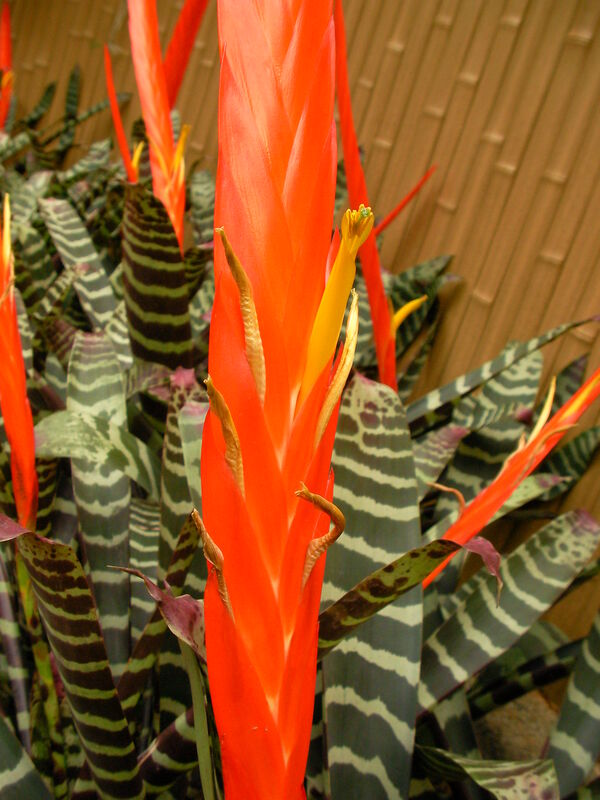
Flaming Sword
Vriesea splendens
Vriesea splendens makes its point with a sword-shaped flower spike — up to 60 cm tall, brilliant scarlet red — from which small yellow tubular flowers emerge one at a time over a period of weeks. The strap-shaped leaves form a water-collecting central cup and are banded with dramatic dark purple-black crossbars on deep green, giving it strong architectural presence even when not in bloom. Like all bromeliads, it blooms once, then channels its energy into producing offsets that carry on the lineage.
How to grow Flaming Sword
bright indirect light (3-6 feet
Keep the central cup about
50-70%
16-27°C
Fast-draining mix is essential -
Remove pups that develop at
Overwatering leads to root or crown rot.
Fun Facts
Vriesea splendens was introduced to European horticulture in 1840 and was awarded the Royal Horticultural Society's Award of Garden Merit — and it has been winning fans ever since.
Pet safe
Non-toxic to cats, dogs, and humans. A safe choice for pet-friendly households.
Sources
- Getting to Know Vriesea | Bromeliads.info (opens in new tab)Botanical Garden
- Flaming Sword Houseplant - Vriesea Info and Care | Gardening Know How (opens in new tab)Reference
- Flaming Sword Houseplant - Vriesea Info and Care | Gardening Know How (opens in new tab)Reference
- Getting to Know Vriesea | Bromeliads.info (opens in new tab)Reference
- Oxford University Plants 400: Vriesea splendens (opens in new tab)Reference
- Vriesea splendens | Wikipedia (opens in new tab)Reference
- Vriesea splendens | Wikipedia (opens in new tab)Reference
- Oxford University Plants 400: Vriesea splendens (opens in new tab)University Extension