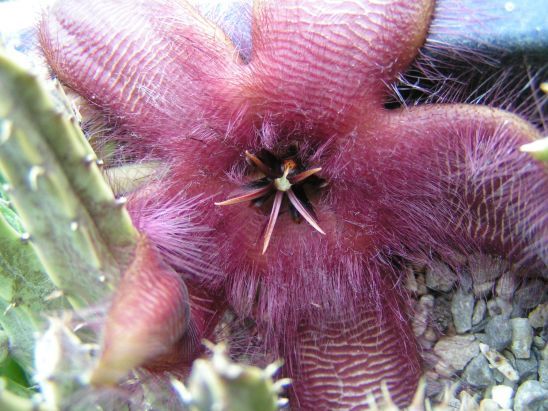
Carrion Flower
Stapelia nobilis
Stapelia nobilis is a leafless, velvety-stemmed succulent that produces large, star-shaped flowers in summer — which smell unmistakably of rotting meat, a feature that is either a selling point or a dealbreaker depending on who you ask. Your plant grows in clumping, angular green stems to about 8 inches tall and spends most of the year looking quietly architectural, then pulls out something spectacular (and pungent) when it blooms. The smell is nature's pollination strategy, not a design flaw.
How to grow Carrion Flower
bright indirect light (3-6 feet
Water moderately during the growing
Tolerates average to low household humidity.
20-30°C
Gritty, fast-draining cactus or succulent mix.
Stem cuttings taken in spring or summer.
Root and stem rot from
Fun Facts
The carrion smell is not random — it is an extremely precise evolutionary mimicry. Blowflies (Calliphoridae) and flesh flies, convinced they have found rotting meat, visit the flower to feed and lay eggs. The flower's complex structure traps the fly's legs or mouthparts just long enough to attach pollen packets before releasing it, effectively hijacking the insect as an unwitting delivery service.
Toxic to pets
Mildly toxic - the sap can cause skin irritation and should be handled with gloves. Some sources note that Stapelia gigantea (a close relative) is listed by the ASPCA as mildly toxic if ingested. Keep away from children and pets as a precaution.
Sources
- Stapelia | PlantZAfrica (opens in new tab)Botanical Garden
- Carrion Flower Stapelia - Giant Cactus Starfish Plant (opens in new tab)Reference
- Carrion Flower Stapelia - Giant Cactus Starfish Plant (opens in new tab)Reference
- Carrion flower - Wikipedia (opens in new tab)Reference
- Carrion flower - Wikipedia (opens in new tab)Reference
- Stapelia - Wikipedia (opens in new tab)Reference
- Stapelia - Wikipedia (opens in new tab)Reference
- Stapelia nobilis (Carrion Flower) - Backyard Gardener (opens in new tab)Reference
- Stapelia nobilis (Carrion Flower) - Backyard Gardener (opens in new tab)Reference
- Stapelia | PlantZAfrica (opens in new tab)Reference