Ming Aralia
Polyscias fruticosa
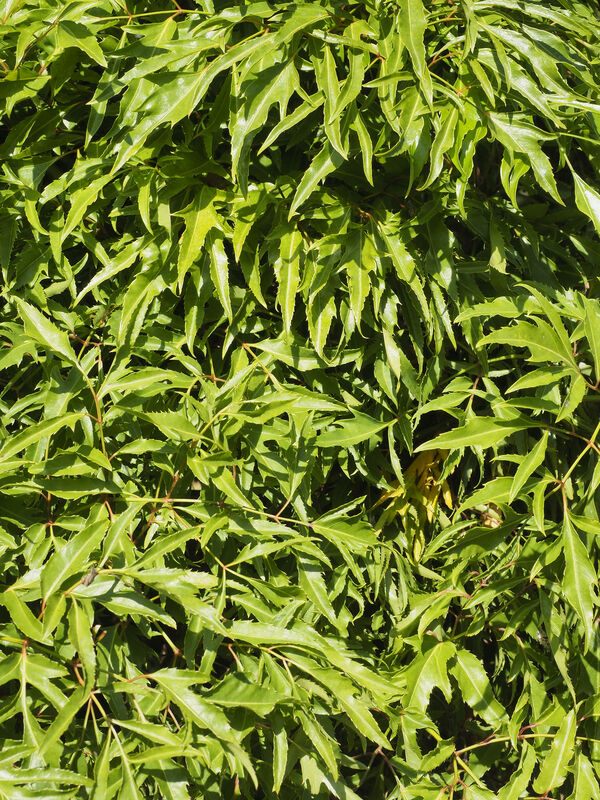
Ming Aralia has the kind of finely divided, feathery foliage that makes it look like someone grew a bonsai tree out of parsley — the intricate leaf texture and gnarly branching structure are genuinely beautiful and get more interesting as the plant ages. Your plant is slow-growing and somewhat dramatic about humidity and temperature consistency, but reward it with a stable warm spot and moisture, and it will hold its elegant form for years. It also has centuries of history in traditional Asian medicine, which adds some character to an already striking plant.
How to grow Ming Aralia
Bright, indirect light.
Keep soil lightly moist during
50-70%
65-85°F
Well-draining, rich potting soil with a pH of 6.
Stem cuttings are most reliable.
Leaf drop is the most
Fun Facts
Young leaves and shoots of Polyscias fruticosa are eaten as a vegetable in Thailand (where it's called 'lep khrut') — cooked in curries or eaten raw in salads. It has been used in Vietnamese and broader Asian folk medicine for centuries as an anti-inflammatory, tonic, and treatment for rheumatism.
Toxic to pets
Mildly toxic to cats, dogs, horses, and humans (ASPCA confirmed). Contains saponins that cause gastrointestinal distress, vomiting, drooling, and mouth irritation if ingested. The sap can cause skin irritation - wear gloves when pruning or propagating.
Sources
- Polyscias fruticosa - Missouri Botanical Garden Plant Finder (opens in new tab)Botanical Garden
- Polyscias fruticosa — Missouri Botanical Garden Plant Finder (opens in new tab)Botanical Garden
- Ming Aralia Care - Smart Garden Guide (opens in new tab)Reference
- Ming Aralia Care — Smart Garden Guide (opens in new tab)Reference
- Polyscias fruticosa - Wikipedia (opens in new tab)Reference
- Polyscias fruticosa — Wikipedia (opens in new tab)Reference
- Polyscias fruticosa - NC State Extension Gardener Plant Toolbox (opens in new tab)University Extension
- Polyscias fruticosa — NC State Extension Gardener Plant Toolbox (opens in new tab)University Extension