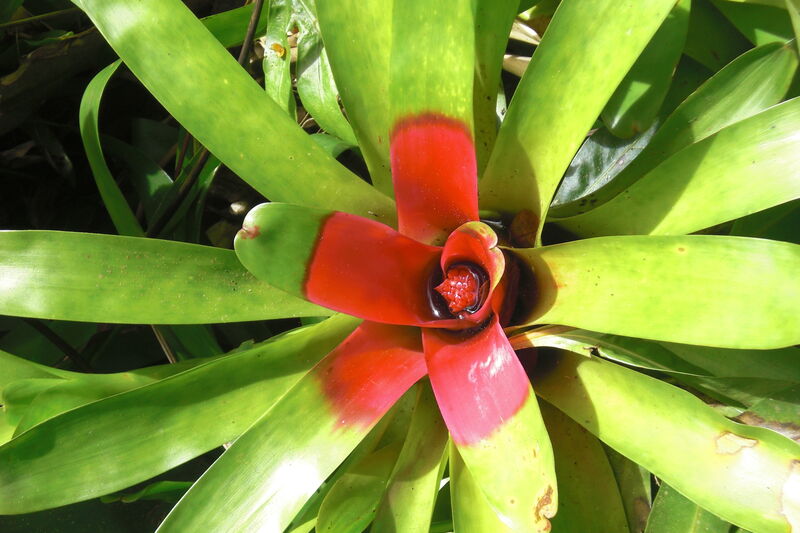
Tricolor Bromeliad
Neoregelia carolinae
You are growing one of the showiest bromeliads in the family, with funnel-shaped rosettes of narrow, leathery, spine-tipped leaves striped in green, creamy-yellow, and rose-red. When your plant is about to flower, the inner leaves flush brilliant crimson -- that 'blush' is where the common name comes from, and it lasts for months. Small violet flowers emerge at the water's surface inside the central cup, and after blooming the mother plant gives way to pups that carry on the show.
How to grow Tricolor Bromeliad
bright indirect light (3-6 feet
Keep the central cup filled
50%
65-80 degrees F (18-27 C) is the sweet spot.
A fast-draining bark-based mix --
Remove pups (offsets) from the
Root rot from overwatering is the main issue.
Fun Facts
The 'Tricolor' variety has never been found in the wild -- it is known only in cultivation and was first formally described by bromeliad specialist Mulford Foster in 1953. Because it doesn't come true from seed, every plant is a vegetative clone passed down through pups.
Pet safe
Non-toxic to dogs, cats, and horses. Safe for households with curious pets and children.
Sources
- Neoregelia carolinae - Plants of the World Online, Kew Science (opens in new tab)Botanical Garden
- Neoregelia carolinae f. tricolor - Missouri Botanical Garden Plant Finder (opens in new tab)Botanical Garden
- Blushing Bromeliad - Neoregelia Carolinae - Grow and Care Guide - House Plants Expert (opens in new tab)Reference
- Blushing Bromeliad - Neoregelia Carolinae - Grow and Care Guide - House Plants Expert (opens in new tab)Reference
- Blushing Bromeliad - University of Arkansas Cooperative Extension (opens in new tab)Reference
- Neoregelia (Blushing Bromeliad, Bromeliad) - NC State Extension Gardener Plant Toolbox (opens in new tab)Reference
- Neoregelia carolinae - Plants of the World Online, Kew Science (opens in new tab)Reference
- Neoregelia carolinae f. tricolor - Missouri Botanical Garden Plant Finder (opens in new tab)Reference
- Blushing Bromeliad - University of Arkansas Cooperative Extension (opens in new tab)University Extension
- Neoregelia (Blushing Bromeliad, Bromeliad) - NC State Extension Gardener Plant Toolbox (opens in new tab)University Extension