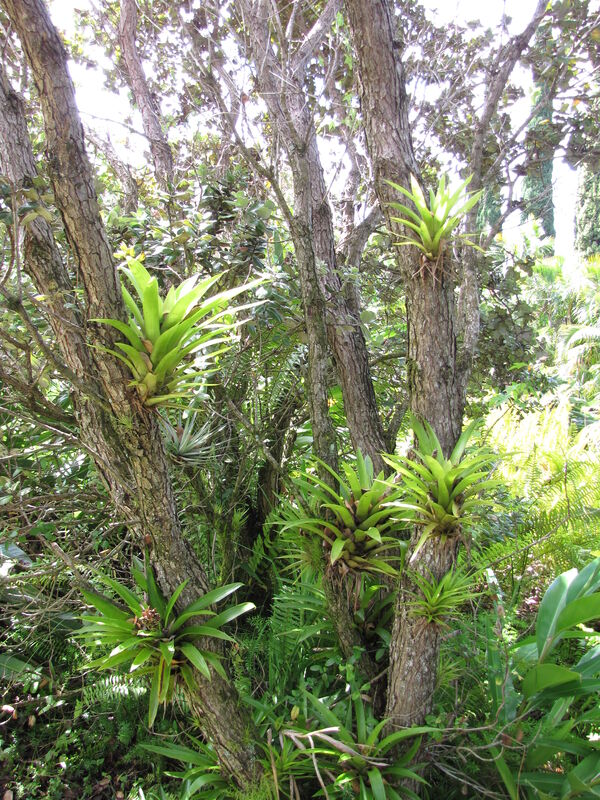
Striped Torch
Guzmania monostachia
Guzmania monostachia produces a rosette of bright green, flexible, slightly striped leaves up to about 40 cm wide, with a striking spike rising above the foliage bearing orange-and-white striped bracts — the lower ones tinged violet, the upper ones deepening to bright red, all framing small white tubular flowers. It is one of the more visually complex Guzmania species with its multi-colored bract arrangement that grades from purple at the base to red at the tip. Care it like its close cousin G. lingulata: water the cup, not the roots.
How to grow Striped Torch
bright indirect light (3-6 feet
Maintain water in the central
50%
65-85°F
Well-draining orchid or bromeliad mix,
After the parent plant flowers
Common pests include mealybugs, spider
Fun Facts
Guzmania monostachia is the only Guzmania species native to the continental United States, occurring naturally in the hammocks and cypress swamps of southern Florida, and it is now threatened with near-extirpation there by an invasive weevil and habitat loss.
Toxic to pets
Not known to be toxic to pets or humans. Ingestion of large quantities may cause mild nausea, vomiting, or loss of appetite, but it is not considered a toxic plant.
Sources
- Guzmania monostachia | Plant Pono (opens in new tab)Botanical Garden
- Guzmania monostachia | striped torch | RHS Plants (opens in new tab)Botanical Garden
- Florida Natural Areas Inventory Field Guide - Guzmania monostachia (opens in new tab)Reference
- Florida Natural Areas Inventory Field Guide - Guzmania monostachia (opens in new tab)Reference
- Guzmania Houseplant Care And Growing Guide - Gardening Know How (opens in new tab)Reference
- Guzmania Houseplant Care And Growing Guide - Gardening Know How (opens in new tab)Reference
- Guzmania monostachia - Encyclopedia of Bromeliads (opens in new tab)Reference
- Guzmania monostachia - Encyclopedia of Bromeliads (opens in new tab)Reference
- Guzmania monostachia | Plant Pono (opens in new tab)Reference
- Guzmania monostachia | striped torch | RHS Plants (opens in new tab)Reference