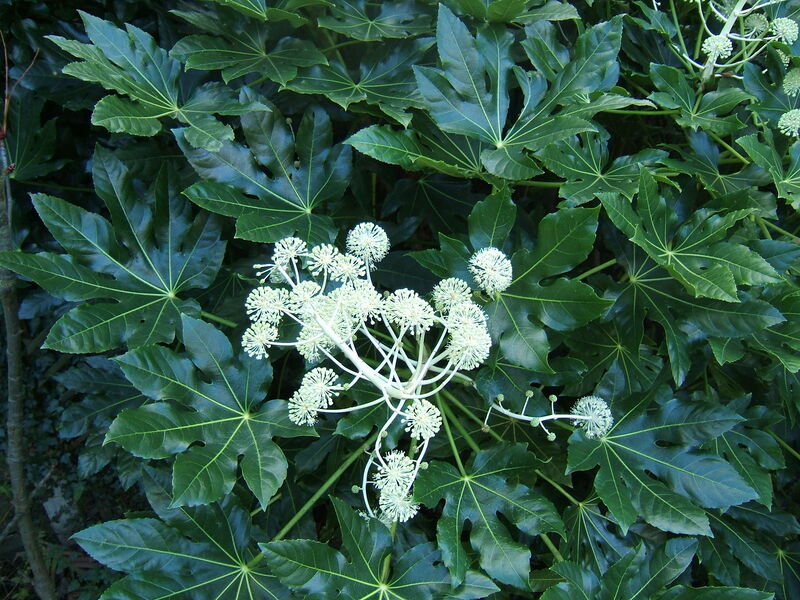
Japanese Aralia
Fatsia japonica
Japanese Aralia makes a dramatic statement with enormous palmate leaves — up to 16 inches across — that look like a giant's hand spread open. It thrives in deep shade where most plants give up, making it one of the better options for dark corners that need some presence. In autumn, mature plants send up tall clusters of small white flowers that are genuinely popular with late-season pollinators when not much else is in bloom.
How to grow Japanese Aralia
Partial to full shade is
Keep soil consistently moist during
Tolerates average indoor humidity.
60-75°F
Moist, well-draining soil (equal parts
Stem tip cuttings (4 inches)
Aphids, mealybugs, spider mites, and scale.
Fun Facts
The genus name Fatsia comes from 'yatsu,' the Japanese word for 'eight,' referring to the typically eight-lobed leaves — so the name Fatsia japonica essentially translates to 'the eight-fingered one from Japan.'
Pet safe
Non-toxic to humans, cats, and dogs per the ASPCA. However, the sticky resinous sap can cause contact dermatitis in people with sensitive skin. Wash hands after handling as a precaution.
Sources
- Fatsia japonica - Wikipedia (opens in new tab)Reference
- Fatsia japonica — NC State Extension Gardener Plant Toolbox (opens in new tab)Reference
- Fatsia japonica — Wikipedia (opens in new tab)Reference
- How to Grow Fatsias - BBC Gardeners' World Magazine (opens in new tab)Reference
- How to Grow Fatsias — BBC Gardeners' World Magazine (opens in new tab)Reference
- Fatsia japonica - NC State Extension Gardener Plant Toolbox (opens in new tab)University Extension