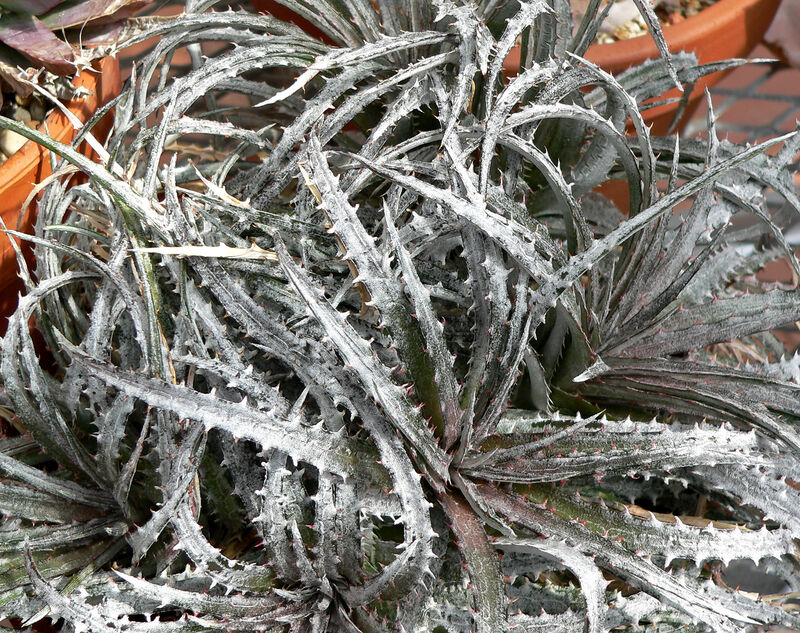
Silver and Gold Dyckia
Dyckia fosterana
Dyckia fosterana is a showstopper for collectors — its rosettes of stiffly arching, silver-grey leaves armed with tiny hooked spines shift to metallic bronze in bright light, and the whole effect looks less like a houseplant and more like jewelry made of blades. It's a terrestrial bromeliad that behaves like a succulent, tolerating drought and full sun while staying compact enough for a windowsill or rock garden. In spring it sends up slender orange-yellow flower spikes from the side of the rosette, not the center, so flowering doesn't kill it.
How to grow Silver and Gold Dyckia
full sun (6 or more
Water abundantly in summer, about
40-60%
Thrives up to 90°F (32°C).
Well-draining succulent or bromeliad mix.
Remove offsets (pups) from the
Root rot from winter overwatering
Fun Facts
The genus Dyckia was named for Prince Joseph zu Salm-Reifferscheidt-Dyck, a 19th-century German botanist and succulent specialist who corresponded extensively with botanists across Europe — an unusually aristocratic namesake for a spiny Brazilian bromeliad.
Toxic to pets
No documented chemical toxicity to humans or pets. The sharp, hooked marginal spines are a significant physical hazard and can easily lacerate skin. Always handle with leather gloves.
Sources
- Dyckia fosteriana | RHS Plant Directory (opens in new tab)Botanical Garden
- Dyckia fosteriana | RHS Plant Directory (opens in new tab)Botanical Garden
- Dyckia Bromeliad Care | Gardening Know How (opens in new tab)Reference
- Dyckia Bromeliad Care | Gardening Know How (opens in new tab)Reference
- Dyckia fosteriana | Plants Rescue (opens in new tab)Reference
- Dyckia fosteriana | Plants Rescue (opens in new tab)Reference
- Dyckia: A Prickly Pitcairnioideae | Bromeliads.info (opens in new tab)Reference
- Dyckia: A Prickly Pitcairnioideae | Bromeliads.info (opens in new tab)Reference
- Learn How to Grow Dyckia Bromeliads | Gardener's Path (opens in new tab)Reference
- Learn How to Grow Dyckia Bromeliads | Gardener's Path (opens in new tab)Reference