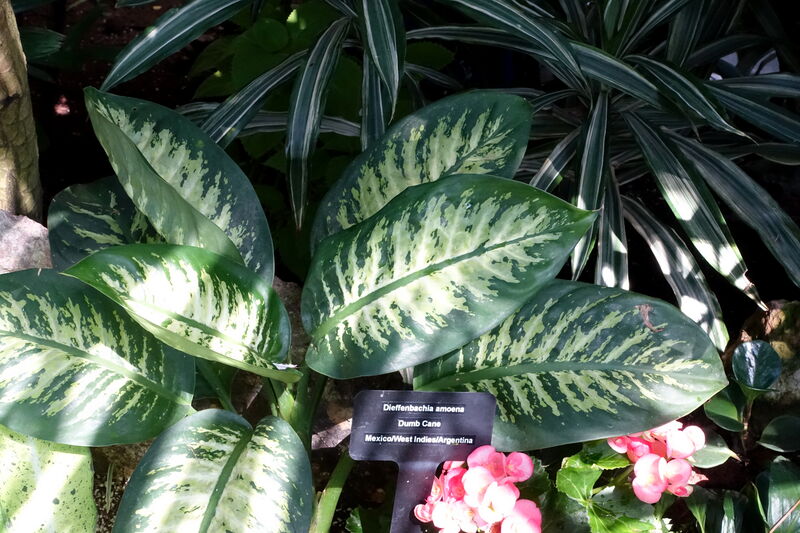
Dieffenbachia amoena
Dieffenbachia amoena
Dieffenbachia amoena is the large, bold statement plant your living room has been waiting for — it can push toward 6 feet tall indoors, with broad, heavily variegated leaves patterned in creamy white and green that catch the eye from across the room. It's tolerant of lower light and some neglect, which makes it a genuinely practical choice for big indoor spaces. Just keep your hands washed after pruning and keep it away from pets — its sap means business.
How to grow Dieffenbachia amoena
bright indirect light (3-6 feet
Allow the top 1-2 inches
50-60%
65-80°F
Rich, well-draining potting mix with
Stem tip cuttings or cane
Root rot from overwatering is the primary killer.
Fun Facts
The common name 'dumb cane' comes from the sap's ability to cause temporary loss of speech by swelling the throat and tongue if chewed — a well-documented effect for centuries.
Toxic to pets
Toxic to dogs, cats, and humans. Contains insoluble calcium oxalate crystals (raphides) and proteolytic enzymes. Chewing any part causes intense oral burning, swelling, excessive drooling, and difficulty swallowing. Severe swelling can cause temporary speech loss - hence the name 'dumb cane.' Keep away from children and pets. Contact ASPCA Poison Control at (888) 426-4435 if ingested.
Sources
- Dieffenbachia Plant Care - How to Grow Dieffenbachia amoena | Soltech (opens in new tab)Reference
- Dieffenbachia Plant Care - How to Grow Dieffenbachia amoena | Soltech (opens in new tab)Reference
- Giant Dumb Cane | ASPCA Toxic and Non-Toxic Plants (opens in new tab)Reference
- Giant Dumb Cane | ASPCA Toxic and Non-Toxic Plants (opens in new tab)Reference
- Dieffenbachia maculata | UF/IFAS Extension (opens in new tab)University Extension
- Dieffenbachia maculata | UF/IFAS Extension (opens in new tab)University Extension
- Dieffenbachia | Clemson Cooperative Extension HGIC (opens in new tab)University Extension
- Dieffenbachia | Clemson Cooperative Extension HGIC (opens in new tab)University Extension
- Dieffenbachia | UConn Home and Garden Education Center (opens in new tab)University Extension
- Dieffenbachia | UConn Home and Garden Education Center (opens in new tab)University Extension