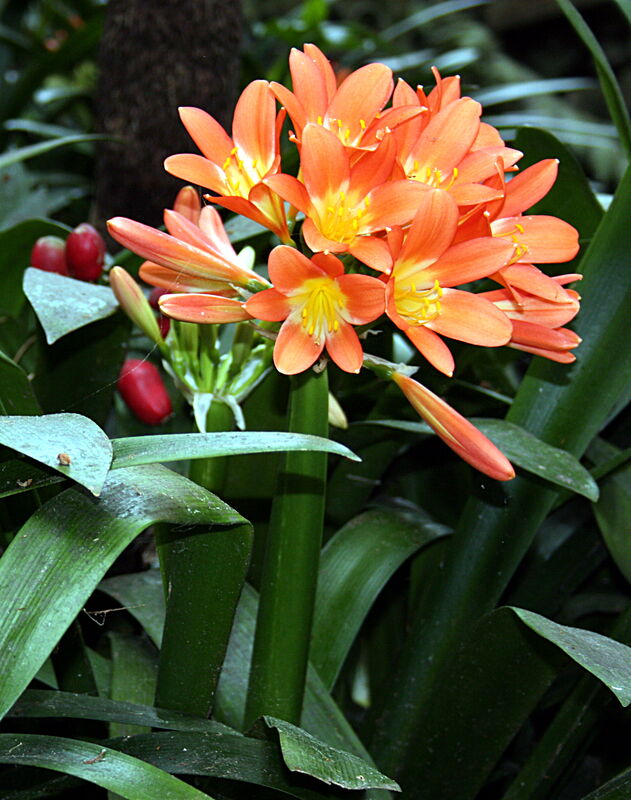
Kafir Lily
Clivia miniata
Clivia miniata is an evergreen perennial that produces spectacular clusters of 12-20 trumpet-shaped orange, red, or yellow flowers on a thick stalk rising from a fan of broad, strap-like leaves. It thrives in low-light conditions where most flowering plants give up entirely, making it one of the most practical and rewarding indoor bloomers you can own. Give it a cool rest in fall and it will reward you every late winter with a flower show that looks like it took way more effort than it actually did.
How to grow Kafir Lily
bright indirect light (3-6 feet
50%
Average household humidity is fine.
65-75°F
Coarse, well-draining mix; an orchid
Division of offsets (pups) is
Mealybugs are the primary pest;
Fun Facts
The genus Clivia was named in 1828 after Lady Charlotte Clive, Duchess of Northumberland, who first flowered the type specimen in England — making this one of the few plants named after a real duchess.
Toxic to pets
Toxic to cats, dogs, and horses. Contains lycorine and other alkaloids, particularly concentrated in the roots and berries. Ingestion can cause vomiting, diarrhea, hypotension, tremors, and in large amounts, potentially serious cardiac effects. Keep away from pets and small children.
Sources
- Clivia miniata - PlantZAfrica (South African National Biodiversity Institute) (opens in new tab)Botanical Garden
- Clivia miniata - PlantZAfrica (South African National Biodiversity Institute) (opens in new tab)Botanical Garden
- Clivia Care - Smart Garden Guide (opens in new tab)Reference
- Clivia Care - Smart Garden Guide (opens in new tab)Reference
- Kaffir Lily Is Toxic To Dogs - Pet Poison Helpline (opens in new tab)Reference
- Kaffir Lily Is Toxic To Dogs - Pet Poison Helpline (opens in new tab)Reference
- Clivia - University of Florida IFAS Gardening Solutions (opens in new tab)University Extension
- Clivia - University of Florida IFAS Gardening Solutions (opens in new tab)University Extension
- Clivia - Wisconsin Horticulture Extension (opens in new tab)University Extension
- Clivia - Wisconsin Horticulture Extension (opens in new tab)University Extension