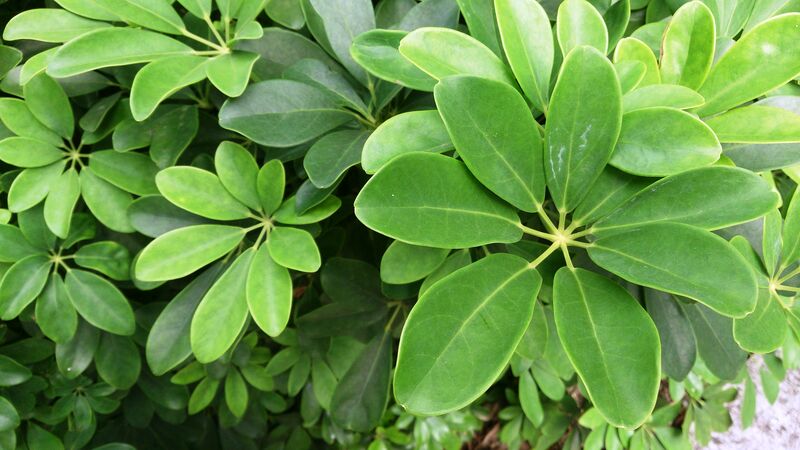
Dwarf Schefflera
Brassaia arboricola
Think of Dwarf Schefflera as the Schefflera that actually fits in your apartment. It grows to a manageable 3-6 feet indoors while keeping all the visual appeal of its larger cousin: glossy, palmate leaves arranged in clusters of 7-9 leaflets that fan out like a tiny umbrella on each stem. In warm climates it can be trained as a bonsai or topiary, but indoors it is most content as a low-fuss statement plant in a bright corner.
How to grow Dwarf Schefflera
bright indirect light (3-6 feet
Water when the top inch of soil is dry.
60-80%
65-75°F
Well-draining, loose potting mix.
Stem cuttings 4-6 inches long
Spider mites, aphids, and mealybugs
Fun Facts
The cultivar 'Gold Capella,' with its yellow-variegated leaves, received the Royal Horticultural Society's Award of Garden Merit, and the species has been a popular bonsai subject since the 1980s thanks to its ability to develop dramatic aerial roots.
Toxic to pets
Toxic to cats and dogs (ASPCA confirmed). Contains calcium oxalate crystals in the sap. Ingestion causes oral irritation, burning sensation in mouth, excessive drooling, difficulty swallowing, and vomiting. Sap can cause skin irritation - wear gloves when pruning.
Sources
- Heptapleurum arboricola - Wikipedia (opens in new tab)Botanical Garden
- Heptapleurum arboricola | NC State Extension Gardener Plant Toolbox (opens in new tab)Botanical Garden
- Heptapleurum arboricola | Plants of the World Online | Kew Science (opens in new tab)Botanical Garden
- Heptapleurum arboricola - Wikipedia (opens in new tab)Reference
- Heptapleurum arboricola | NC State Extension Gardener Plant Toolbox (opens in new tab)Reference
- Heptapleurum arboricola | Plants of the World Online | Kew Science (opens in new tab)Reference
- Schefflera Arboricola Plant: Dwarf Umbrella Tree Growing And Care (opens in new tab)Reference
- Schefflera Arboricola Plant: Dwarf Umbrella Tree Growing And Care (opens in new tab)Reference
- Toxic and Non-toxic Plants: Schefflera | ASPCA (opens in new tab)Reference
- Toxic and Non-toxic Plants: Schefflera | ASPCA (opens in new tab)Reference
- Umbrella Plant Care Guide (Schefflera Arboricola) (opens in new tab)Reference
- Umbrella Plant Care Guide (Schefflera Arboricola) (opens in new tab)Reference