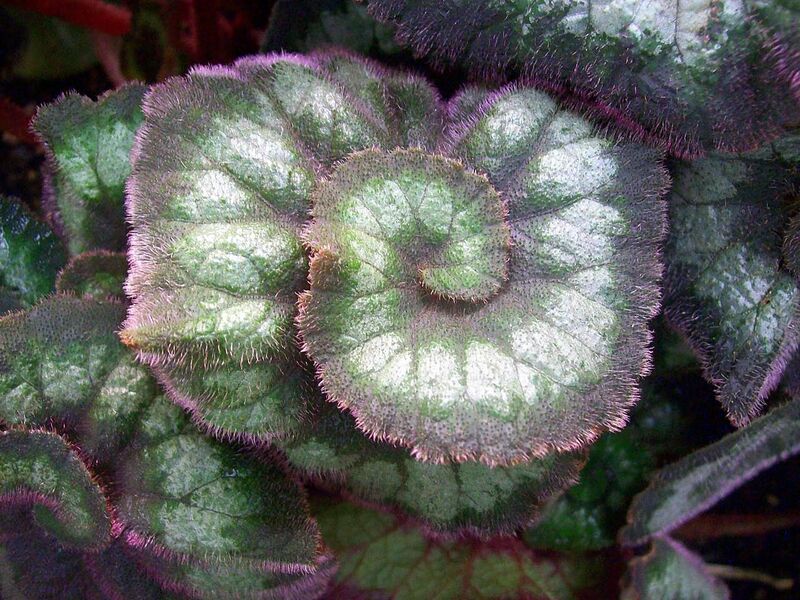
Rex Begonia
Begonia rex-cultorum
Rex Begonias are grown almost entirely for their foliage, and justifiably so -- the leaves are among the most visually spectacular of any houseplant, displaying swirling patterns of silver, red, burgundy, purple, green, and bronze in combinations that look like they were painted by hand. You are actually growing a hybrid group descended from the wild Begonia rex of Assam, crossed with other rhizomatous species starting in the 1850s, which has produced over 500 named cultivars. They need more attention than most begonias -- get the humidity and watering right and the payoff is genuinely stunning.
How to grow Rex Begonia
bright indirect light (3-6 feet
Water when the top inch
60-70%
60-70°F
Well-draining mix rich in organic
Leaf cuttings are the classic
Powdery mildew and botrytis are
Fun Facts
Begonia rex arrived in England as a stowaway -- it germinated from an orchid bulb imported from Assam at the height of Victorian plant mania, was reportedly valued at 10,000 francs when first offered commercially, and dropped to a merely expensive 50 francs per plant by 1858.
Toxic to pets
Toxic to cats, dogs, and horses per ASPCA. Soluble calcium oxalate crystals cause vomiting, salivation, and kidney failure in grazing animals. Roots are the most toxic part. Contact the ASPCA Poison Control Center (888-426-4435) if a pet ingests any part.
Sources
- Rex Begonia - ASPCA Toxic and Non-toxic Plants (opens in new tab)ASPCA
- A Beginner's Guide to Begonias: Begonia rex-cultorum - University of Florida IFAS (opens in new tab)Reference
- How to Grow and Care for Rex Begonias Indoors - Gardener's Path (opens in new tab)Reference
- How to Grow and Care for Rex Begonias Indoors - Gardener's Path (opens in new tab)Reference
- Rex Begonia (Begonia rex-cultorum) - Gardenia.net (opens in new tab)Reference
- Rex Begonia (Begonia rex-cultorum) - Gardenia.net (opens in new tab)Reference
- Rex Begonia - ASPCA Toxic and Non-toxic Plants (opens in new tab)Reference
- Rex Cultorum Begonias: Gloriously Gaudy - American Begonia Society (opens in new tab)Reference
- Rex Cultorum Begonias: Gloriously Gaudy - American Begonia Society (opens in new tab)Reference
- A Beginner's Guide to Begonias: Begonia rex-cultorum - University of Florida IFAS (opens in new tab)University Extension