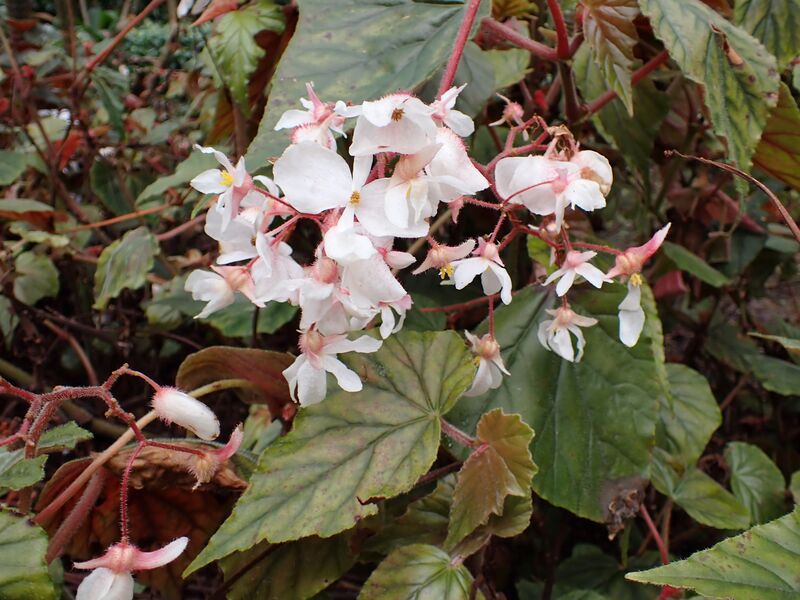
Begonia haageana
Begonia haageana
Begonia haageana -- also widely sold as Begonia scharffii -- is a Victorian-era houseplant favorite from Brazil that earns the 'Hairy Begonia' nickname honestly: the entire plant, from stems to leaves to flower buds, is covered in soft white bristles that give it a velvety, frosted appearance. The leaves grow large and dramatically asymmetrical, olive-green on top and deep burgundy underneath, and the cascading clusters of white flowers with red hairs bloom from June through November. It is a genuinely striking plant with an antique, slightly theatrical look.
How to grow Begonia haageana
bright indirect light (3-6 feet
Allow the top inch of
60-80%
Not frost-hardy; only evergreen outdoors
Well-draining mix rich in nutrients;
Stem cuttings are the most
Powdery mildew is the main
Fun Facts
The white bristles covering Begonia haageana are not decorative -- they are functional trichomes that help protect the plant from desiccation and pest damage, and also trap small water droplets in the humid Brazilian forest air.
Toxic to pets
Toxic to cats and dogs (calcium oxalate crystals); roots and tubers are the most toxic part. Keep away from pets.
Sources
- Begonia - ASPCA Toxic and Non-toxic Plants (opens in new tab)ASPCA
- Begonia - ASPCA Toxic and Non-toxic Plants (opens in new tab)Reference
- Begonia scharffiana (Elephant-Ear Begonia) - NC State Extension Gardener Plant Toolbox (opens in new tab)Reference
- Elephant Ear Begonia (Begonia haageana) - myGarden.org (opens in new tab)Reference
- Elephant Ear Begonia (Begonia haageana) - myGarden.org (opens in new tab)Reference
- Grow Perfect Elephant Ear Begonia: Pro Tips and Full Guide (opens in new tab)Reference
- Grow Perfect Elephant Ear Begonia: Pro Tips and Full Guide (opens in new tab)Reference
- How to grow elephant ear begonia - Better Homes and Gardens Australia (opens in new tab)Reference
- How to grow elephant ear begonia - Better Homes and Gardens Australia (opens in new tab)Reference
- Begonia scharffiana (Elephant-Ear Begonia) - NC State Extension Gardener Plant Toolbox (opens in new tab)University Extension