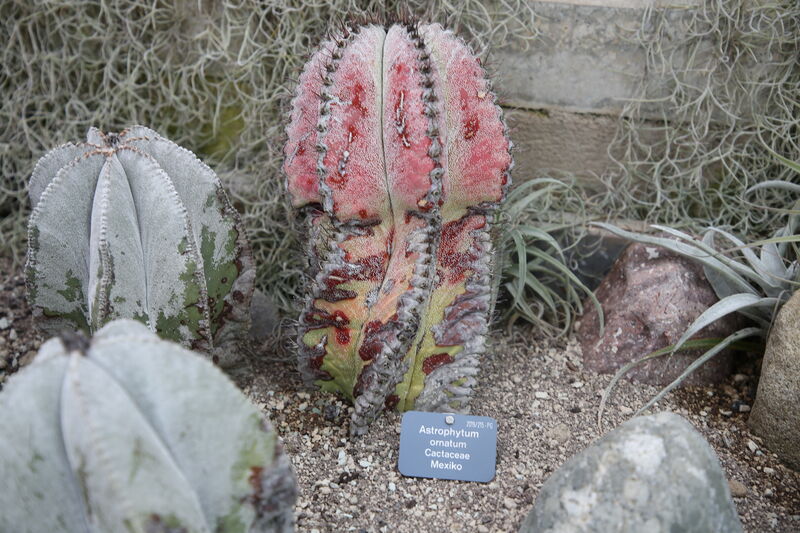
the bishop's cap or monk's hood cactus
Astrophytum ornatum
The Monk's Hood Cactus is the largest and arguably the most dramatic of the Astrophytum genus, eventually growing into a tall column up to 6 feet in the wild, adorned with eight spiraling ribs, bold spines, and diagonal bands of white woolly scales. It starts as a globe in youth and gets more columnar and architectural as it ages, eventually producing large, bright yellow flowers at the crown when it matures. Compared to its spineless cousin the Bishop's Cap, this one means business -- those spines are real.
How to grow the bishop's cap or monk's hood cactus
Needs at least 6 hours
water sparingly (water small amounts, less often.
60-80%
Prefers warm summers above 70°F
Sandy, fast-draining cactus mix with a pH of 5.
Primarily seed-grown; sow fresh seeds
Root rot from overwatering is the main threat.
Fun Facts
Astrophytum ornatum is listed as Vulnerable on the IUCN Red List, threatened by habitat loss from livestock grazing, mining, land conversion, and illegal collection; it is also protected under Appendix II of CITES.
Pet safe
Non-toxic to humans and pets. The spines are the main physical hazard -- handle with folded newspaper or thick gloves.
Sources
- Astrophytum ornatum - RHS Plant Directory (opens in new tab)Botanical Garden
- Astrophytum (Star Cactus) - NC State Extension Gardener Plant Toolbox (opens in new tab)Reference
- Astrophytum Cactus Care: Tips For Growing A Monk's Hood Plant - Gardening Know How (opens in new tab)Reference
- Astrophytum Cactus Care: Tips For Growing A Monk's Hood Plant - Gardening Know How (opens in new tab)Reference
- Astrophytum ornatum (Monk's Hood Cactus) - World of Succulents (opens in new tab)Reference
- Astrophytum ornatum (Monk's Hood Cactus) - World of Succulents (opens in new tab)Reference
- Astrophytum ornatum - RHS Plant Directory (opens in new tab)Reference
- Star Cactus (Astrophytum ornatum) - Gardenia.net (opens in new tab)Reference
- Star Cactus (Astrophytum ornatum) - Gardenia.net (opens in new tab)Reference
- Astrophytum (Star Cactus) - NC State Extension Gardener Plant Toolbox (opens in new tab)University Extension