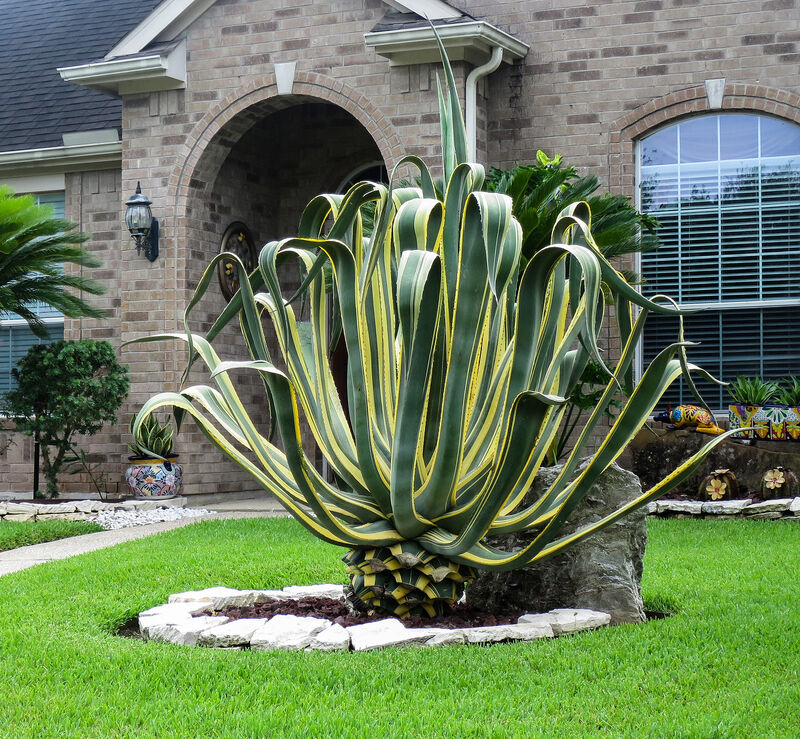
Variegated Century Plant
Agave americana
The Variegated Century Plant is a bold architectural succulent forming a massive rosette of blue-green leaves edged in creamy yellow -- each one tipped with a spine that means business. It spends years looking dramatic and doing very little, then sends up a flower stalk up to 30 feet tall in one spectacular finale before dying. Your job is mostly to stand back and admire it, then collect the pups it leaves behind.
How to grow Variegated Century Plant
full sun (6 or more
Extremely drought tolerant (can go
60-80%
Hardy in USDA zones 8-11.
Fast-draining sandy or rocky soil is essential.
Collect and pot the offsets
Root rot from overwatering or
Fun Facts
Despite being called 'American aloe,' Agave americana is not related to true aloes at all -- it is actually a close relative of asparagus.
Toxic to pets
Mildly toxic to cats, dogs, and horses via saponins and calcium oxalate crystals. Can cause vomiting, diarrhea, and lethargy. The needle-sharp leaf tips are also a puncture hazard.
Sources
- Toxic and Non-Toxic Plants - ASPCA (opens in new tab)ASPCA
- Toxic and Non-Toxic Plants - ASPCA (opens in new tab)ASPCA
- Agave americana 'Marginata' (Variegated Century Plant) - World of Succulents (opens in new tab)Reference
- Agave americana 'Marginata' (Variegated Century Plant) - World of Succulents (opens in new tab)Reference
- Agave americana (Century Plant): All You Need To Know - Gardenia.net (opens in new tab)Reference
- Agave americana (Century Plant): All You Need To Know - Gardenia.net (opens in new tab)Reference
- Agave americana - Wikipedia (opens in new tab)Reference
- Agave americana - Wikipedia (opens in new tab)Reference
- Agave (Century Plant) - NC State Extension Gardener Plant Toolbox (opens in new tab)University Extension
- Agave (Century Plant) - NC State Extension Gardener Plant Toolbox (opens in new tab)University Extension