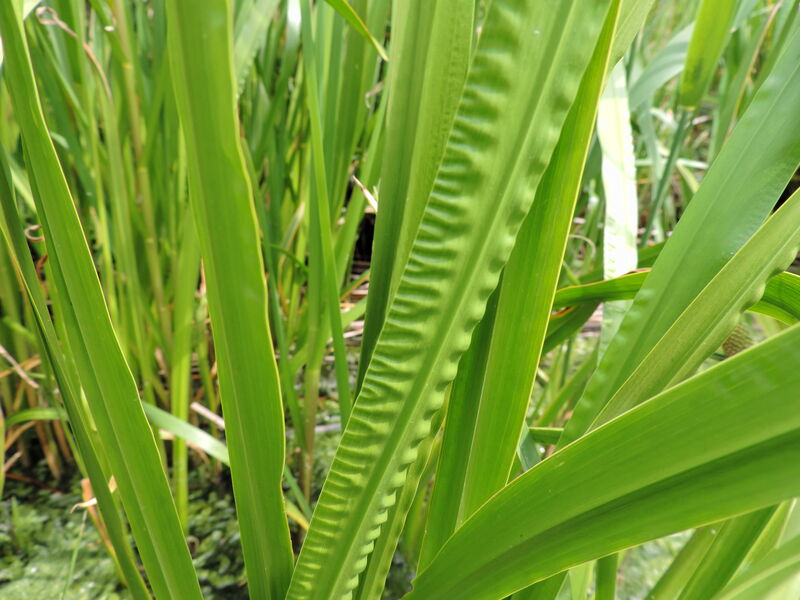
Sweet Flag
Acorus calamus
Sweet flag is a striking aquatic and bog plant with tall, sword-like leaves that smell pleasantly of cinnamon and citrus when you brush them — it has been used in perfumery, traditional medicine, and as a flavoring for centuries. What most people do not know is that the FDA banned it as a food additive in 1968 because certain Asian varieties contain beta-asarone, a compound that proved carcinogenic in high-dose rat studies. The diploid North American strain does not contain beta-asarone, so the toxicity risk really depends on which variety you have.
How to grow Sweet Flag
Prefers at least 4 hours
This is a bog and
60-80%
Comfortable in 60 to 75°F (15 to 24°C) indoors.
Use a mix that retains
Divide the rhizome clumps in early spring.
This plant is notably pest-resistant.
Fun Facts
The FDA banned Acorus calamus as a food additive in 1968 after studies showed that beta-asarone, found in certain Asian varieties, was carcinogenic in rats — but the safe diploid North American strain contains none of this compound.
Toxic to pets
The Asian triploid and tetraploid varieties contain beta-asarone, which is a procarcinogen - the FDA banned these from food use in 1968. The North American diploid variety does not contain beta-asarone. As a houseplant it is not something you would be ingesting, but if you have pets or children who chew on plants, exercise caution. The ASPCA does not explicitly list it in their toxic plant database, but the beta-asarone content in Asian varieties warrants keeping it out of reach.
Sources
- Sweet Flag (Calamus) - Missouri Department of Conservation (opens in new tab)Botanical Garden
- Sweet Flag (Calamus) — Missouri Department of Conservation (opens in new tab)Botanical Garden
- Acorus Calamus Sweet Flag Plant Care Guide - Bantam Earth (opens in new tab)Reference
- Acorus Calamus Sweet Flag Plant Care Guide — Bantam Earth (opens in new tab)Reference
- Acorus calamus - Plants For A Future Database (opens in new tab)Reference
- Acorus calamus - Wikipedia (opens in new tab)Reference
- Acorus calamus — Plants For A Future Database (opens in new tab)Reference
- Acorus calamus — Wikipedia (opens in new tab)Reference